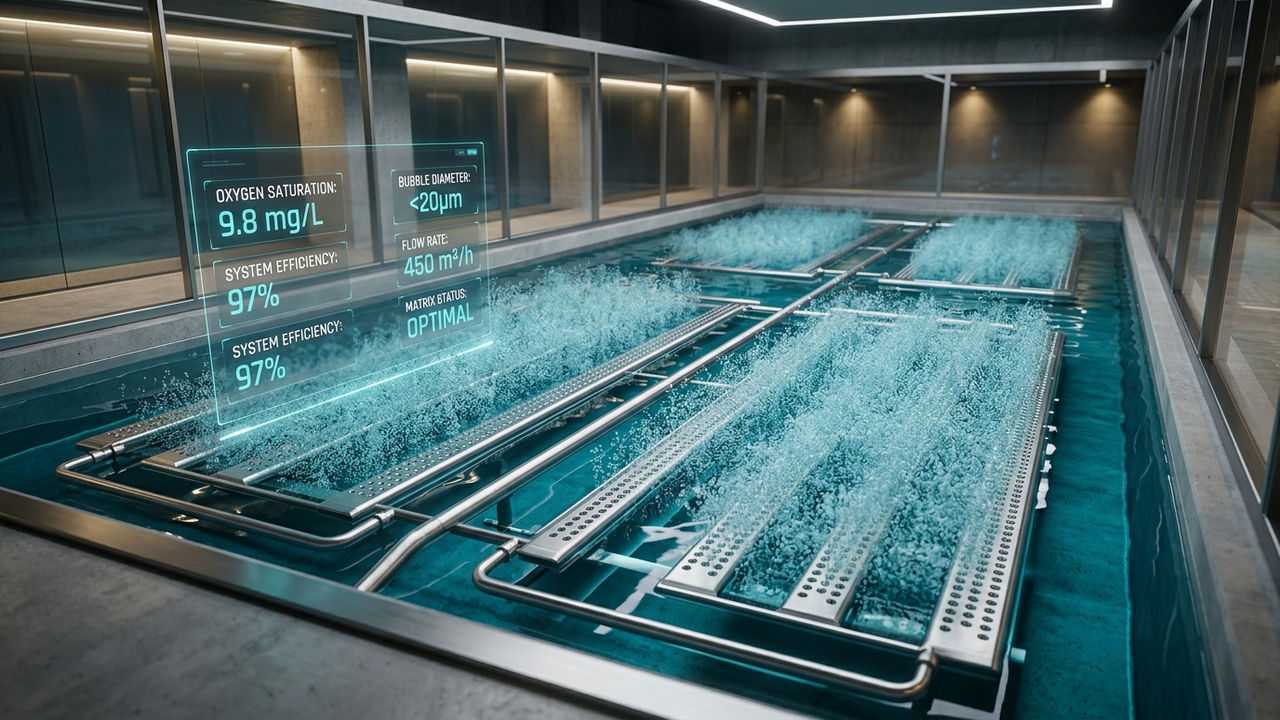
Aeration is the single largest energy consumer in municipal and industrial biological wastewater treatment plants, often accounting for 50% to 80% of total electricity costs. Standard surface aerators or fine-bubble compressed air systems blow ambient air (which consists of about 78% inert nitrogen and only 21% oxygen) into the activated sludge tanks. This article analyzes how using pure oxygen (O2) instead of air dramatically increases transfer rates, expands capacity, and reduces energy consumption.
Key Thesis
Using pure oxygen instead of air increases the concentration gradient by a factor of nearly five. This accelerates the biological process, allows higher biomass concentrations, and significantly reduces the carbon footprint and off-gas volumes.
The Thermodynamics of Oxygen Transfer
The rate at which oxygen dissolves in water is described by Henry's Law and the mass transfer equation:
SOTR = K_L * a * (C_s - C)
Where Cs is the oxygen saturation concentration and C is the current dissolved oxygen level. When bubbling ambient air, the partial pressure of oxygen is only about 0.21 bar, limiting Cs at 20 °C to approx. 9 mg/L. By contrast, when using pure oxygen (93–99% purity), the partial pressure rises to nearly 1 bar, elevating the saturation concentration Cs to over 40 mg/L.
This massive increase in the driving concentration gradient (Cs - C) multiplies the mass transfer rate. Consequently, the aeration system needs to transfer far less total gas volume to dissolve the same amount of oxygen, saving substantial compressor energy.
Key Advantages of Pure Oxygen Aeration
1. High Biomass Concentration and Compact Footprint
Because oxygen is no longer a limiting factor, plants can operate at higher mixed liquor suspended solids (MLSS) levels (e.g. 6–10 g/L instead of the typical 3–4 g/L). This increases the treatment capacity of existing aeration tanks by up to 100% without requiring new concrete basins, which is ideal for industrial plants facing space constraints.
2. Drastic Off-Gas Reduction
Since inert nitrogen (N2) is not bubbled through the water, the volume of off-gas is reduced by up to 95%. This solves several operational challenges: it minimizes foaming, prevents wastewater cooling in winter (stripping effect), and significantly reduces odors and aerosol emissions, protecting the health of the operating staff.
3. Process Stability and Load Balancing
Pure oxygen serves as an excellent process backup. During industrial shock loads (such as during harvest season in food processing, tourism peaks, or industrial chemical batch dumps), pure oxygen can be dosed dynamically to prevent the activated sludge system from collapsing due to oxygen depletion.
Conclusion
While compressed air is suitable for low-loaded municipal plants, pure oxygen aeration is the technology of choice for highly loaded industrial applications and space-constrained municipal upgrades. The thermodynamic advantage of the five-fold higher concentration gradient translates directly into process stability, footprint reduction, and energy efficiency.
Request an Engineering Audit or Feasibility Study
Are you evaluating quaternary treatment stages, looking to optimize oxygen gas dissolution efficiency, or dealing with PFAS remediation? Get in touch for an independent engineering review.
Schedule Engineering Review →