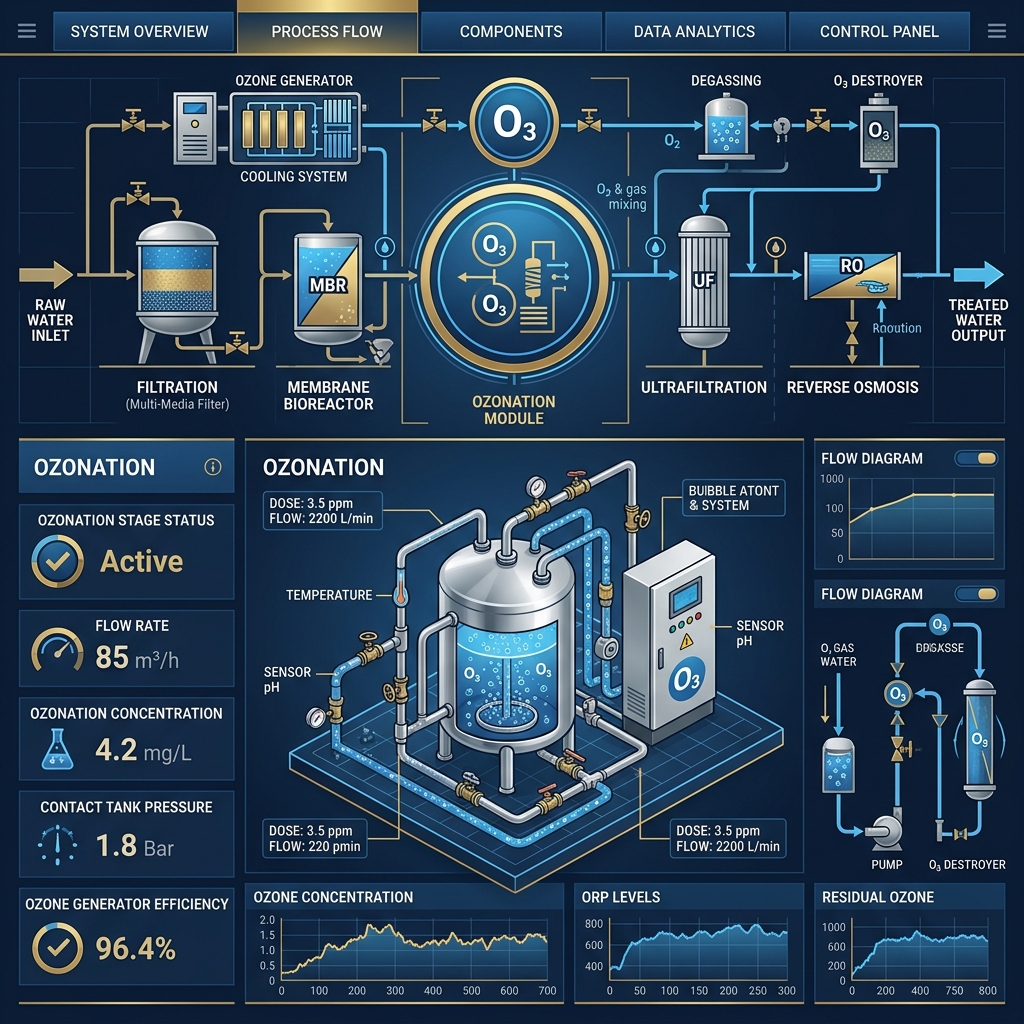
The removal of anthropogenic micropollutants (pharmaceutical residues, micro-contaminants, and pesticides) is a major goal of modern wastewater plants. However, direct ozone (O3) gas injection frequently faces physical limitations: large bubbles lead to non-uniform gas entry, high off-gas losses, and local concentration spikes that trigger carcinogenic bromate formation. The innovative "Ozone Strong Water Dosing" process solves these challenges by separating the ozone dissolution stage from the target pollutant reaction.
Research Focus
By preparing a highly concentrated ozone-water stream ("strong water") in a sidestream loop and subsequently injecting it into the main wastewater flow, mass transfer is maximized and bromate formation is minimized. This method was published in 2024 by Dr. Markus Meier (Air Liquide) in collaboration with HZDR (CLEWATEC) in the journal Ozone: Science & Engineering.
The Chemical Engineering Principle
In classical ozonation, an ozone-oxygen gas mixture is directly diffused into the wastewater. Since ozone has limited solubility in water, a portion of the gas escapes unutilized into the exhaust air. Under the "Strong Water Dosing" scheme, pure oxygen (LOX-based) is ozonated and dissolved in a small, pressurized side-stream of clean water or filtered effluent. This creates a highly concentrated liquid ozone stream (concentrations of 50 to over 80 mg/L of dissolved ozone).
This "strong water" is then dosed into the main wastewater stream via static mixers and multi-port injection nozzles. Since the ozone is already completely dissolved, the gas-liquid mass transfer limitation in the main flow is entirely eliminated. The reaction with dissolved micropollutants occurs almost instantaneously and homogeneously.
Advantages Over Direct Gas Diffusion
1. Suppression of Bromate Formation
A major concern in bromide-rich wastewater is the formation of carcinogenic bromate (BrO3-). At the boundary layer of rising ozone gas bubbles, extreme concentration spikes oxidize bromide rapidly. Because Strong Water Dosing introduces no gas bubbles into the main stream, these local hot-spots are avoided, reducing bromate formation by up to 70%.
2. High Gas Efficiency and Lower Operating Costs
Since gas dissolution occurs under optimal, pressurized conditions in a closed sidestream, nearly all generated ozone dissolves in the water. Off-gas losses are minimized. This significantly reduces the oxygen demand of the generator, saving substantial power and reducing the cost of residual ozone destructors.
3. Simplified Retrofitting
Traditional ozone contact basins require deep concrete tanks (often > 5–6 meters water depth) to achieve sufficient hydrostatic pressure for gas dissolution. Strong Water Dosing does not require deep basins and can be easily retrofitted into existing pipelines or shallow contact tanks, lowering capital expenditure by up to 40%.
Conclusion
The Ozone Strong Water Dosing method developed by Dr. Markus Meier represents a milestone in industrial gas applications for environmental engineering. It combines highly efficient pollutant barriers with maximum process safety and resource efficiency, offering a scalable alternative for municipal and industrial plants planning a quaternary treatment upgrade.
Peer-reviewed publication:
K. F. Guerrero-Granados, J. Mante, M. Joy, M. Meier, A. Boergers, S. Panglisch, J. Tuerk (Published: September 2, 2024).
Ozone: Science & Engineering, Vol. 46 (5), 392–406. ✓ Open Access
DOI: 10.1080/01919512.2024.2336973
Co-authors (with ORCID):
K. F. Guerrero-Granados, Jan Mante, Midhun Joy, Markus Meier, Andrea Boergers, Stefan Panglisch, Jochen Tuerk
Funding & collaboration: Deutsche Bundesstiftung Umwelt (DBU), grant Az. 20022-008
Full-scale installation at WWTP Duisburg-Vierlinden
Request an Engineering Audit or Feasibility Study
Are you evaluating quaternary treatment stages, looking to optimize oxygen gas dissolution efficiency, or dealing with PFAS remediation? Get in touch for an independent engineering review.
Schedule Engineering Review →