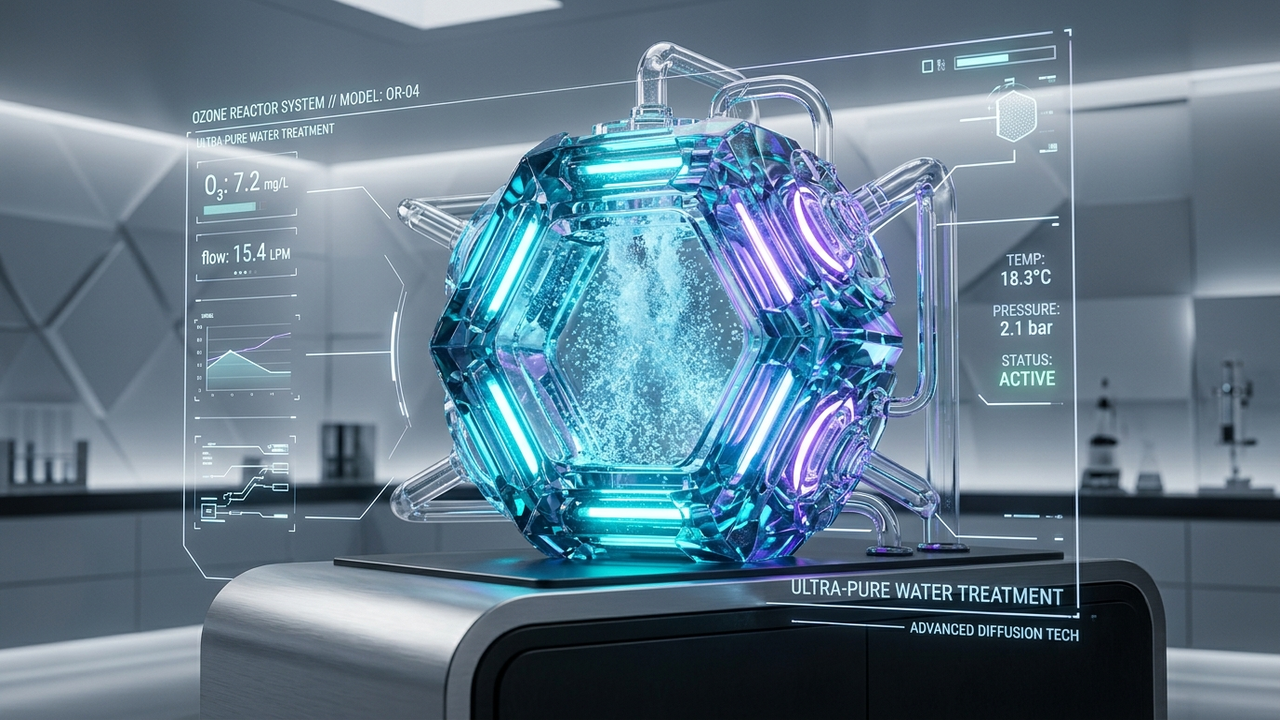
The requirements for modern wastewater treatment are rising continuously on a global level. Micropollutants, persistent pharmaceutical residues, endocrine disruptors, and microplastics present municipal and industrial wastewater plants with immense technological challenges that can no longer be met with conventional biological and mechanical stages. This is where ozone (O3), as one of the strongest technically available oxidizing agents, comes into play and defines the state of the art.
Core Thesis
Ozonation is no longer an experimental process, but the scalable backbone of the quaternary treatment stage. By breaking down complex anthropogenic micropollutants directly at the source, it effectively prevents the accumulation of toxic substances in our receiving waters and ecosystems.
Physical-Chemical Operation
Ozone is a highly reactive molecule consisting of three oxygen atoms. It is generated directly on-site at the wastewater plant from pure oxygen (O2) or cryogenic liquid oxygen (LOX) via silent electrical discharges in specialized ozone generators. When this ozone-gas mixture is introduced into the wastewater via fine-bubble aeration systems or injectors, it unfolds its enormous oxidative power.
It breaks even highly complex and biologically non-degradable molecular structures (such as those of diclofenac, X-ray contrast media, or industrial chemicals) by direct attack on double bonds. This process splits the large macromolecules into smaller, often biodegradable fragments. These fragments can then be finally metabolized and removed by microorganisms in a subsequent stage (e.g., a biologically active sand or activated carbon filter).
Decisive Advantages for Water Management
1. Maximum Elimination Rates
Unlike passive filter media, ozone reacts actively with pollutants. With correct design and dosing, 80–90% of the relevant target micropollutants are reliably oxidized. This clearly exceeds regulatory requirements (e.g., the specifications of the EU's amended Urban Wastewater Treatment Directive) in most cases.
2. Environmentally Friendly Decomposition (No Secondary Waste)
A massive logistical and economic advantage over pure powdered activated carbon (PAC) dosing is the lack of residues. Ozone decomposes back into ordinary oxygen (O2) after the reaction or through a simple residual ozone destructor. No contaminated sludge or spent filter media are generated, which would otherwise have to be incinerated at high cost.
3. Synergy Effects: Disinfection and Decolorization
In addition to the primary task of micropollutant elimination, ozone causes significant pathogen reduction. Cell walls of viruses and multi-resistant bacteria are destroyed, which is invaluable especially for the planned reuse of wastewater (water reuse) for agricultural purposes. At the same time, oxidation leads to visual clarification and decolorization of the effluent, which greatly increases acceptance when discharging into sensitive waters.
Process Control and Challenges
Despite its outstanding properties, ozonation requires precise engineering. Overdosing in the presence of bromide in the wastewater can lead to the formation of the undesirable byproduct bromate. Modern plants therefore use high-resolution online sensors (e.g., UV absorption at 254 nm) to adjust the ozone dose dynamically in real-time to the current load and strictly suppress secondary reactions.
Conclusion
Ozonation is establishing itself as the centerpiece of the quaternary treatment stage. For operators of large wastewater treatment plants, it offers an economic, highly efficient, and future-proof solution to elevate water protection to a new level in the 21st century. The combination of ozone and subsequent biological filtration is currently the most powerful barrier system against the micro-contaminants of our modern society.
Request an Engineering Audit or Feasibility Study
Are you evaluating quaternary treatment stages, looking to optimize oxygen gas dissolution efficiency, or dealing with PFAS remediation? Get in touch for an independent engineering review.
Schedule Engineering Review →