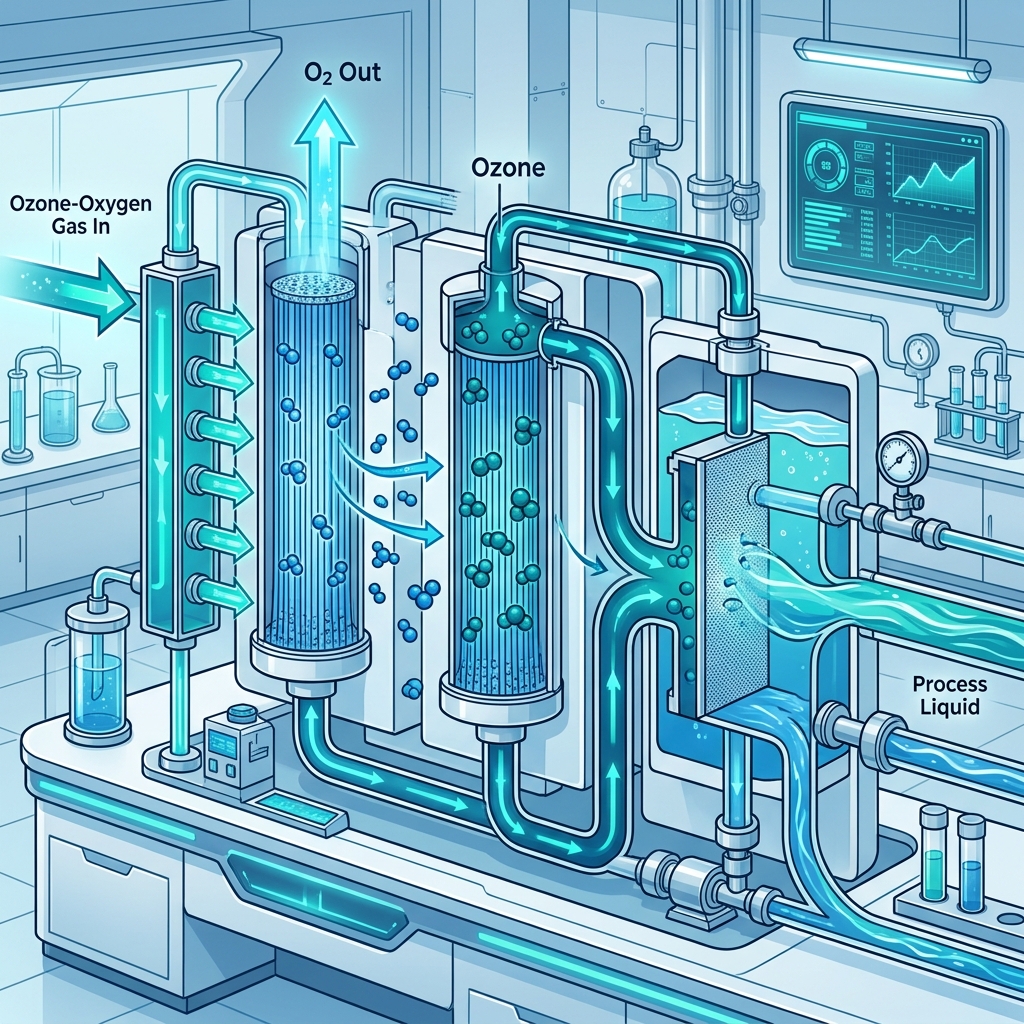
The generation of highly concentrated ozone gas (O3) and its efficient injection into liquid phases are crucial factors in industrial gas applications. Conventional ozone generators produce ozone-oxygen mixtures with low ozone concentrations (approx. 1% to 15%). For demanding applications in chemical synthesis, semiconductor manufacturing, and advanced water treatment, however, much higher purities and precise injection methods are required.
Research Focus
The combination of selective cryogenic adsorption (ozone enrichment) and bubble-free gas entry via hydrophobic hollow fiber membranes (membrane contactors) enables maximum mass transfer rates with minimal gas loss, suppressing undesirable byproducts such as bromate.
Ozone-Oxygen Separation: Enrichment Methods
To separate ozone from unreacted oxygen after corona discharge, two primary approaches are followed:
- Cryogenic Adsorption (TSA/PSA): At temperatures of approx. -50 °C to -70 °C, ozone adsorbs selectively on silica gel or high-silica hydrophobic zeolites, while oxygen escapes in gaseous form and is recycled. Highly concentrated ozone gas is desorbed by subsequent pressure reduction (vacuum) or temperature increase. Modern zeolitic adsorbents offer the advantage of being insensitive to residual moisture.
- Ozone-Selective Membrane Separation: Patents such as US 6,190,436 describe the use of elastic polymer membranes. Ozone diffuses preferentially through the membrane layer due to its molecular properties and is withdrawn on the permeate side, while the oxygen retentate stream is returned directly to the generator.
Efficient Gas Injection via Membrane Contactors
In industrial gas injection, hydrophobic hollow fiber membrane contactors (made of materials such as PTFE or PVDF) are increasingly gaining importance over classical Venturi nozzles or bubble columns:
1. Bubble-Free Mass Transfer
Water flows along the outside (shell side) of the hydrophobic hollow fibers, while the ozone gas is routed through the lumen (inside). The pores of the membrane are gas-filled but are not flooded by water due to capillary pressure. Ozone dissolves without bubbles in the passing water by pure molecular diffusion. This eliminates operational issues such as gas stripping and foaming.
2. Minimizing Bromate Formation (BrO3-)
In drinking water, local ozone oversaturation at the interface of rising gas bubbles leads to the undesirable oxidation of natural bromide into carcinogenic bromate. Because membrane contactors guarantee a homogeneous, boundary-layer-controlled distribution of ozone in the water flow, this reaction pathway is drastically suppressed. This significantly increases safety in municipal drinking water disinfection.
3. Flow Optimization and Static Mixers
Since the main transport resistance for ozone lies on the liquid-side boundary layer, recent patents (such as the patent TU Berlin 14025/TUB) describe the use of integrated static mixers. These generate targeted micro-turbulences at the fiber surfaces and increase the mass transfer coefficient (kL) multiple times over.
Outlook
The synergy of highly efficient adsorption processes for ozone enrichment and precise gas injection via hollow fiber membranes represents the future of industrial oxidation. By recycling the oxygen loop directly, operating costs of gas supply can be reduced by up to 80%, while process quality is elevated to a new level.
Request an Engineering Audit or Feasibility Study
Are you evaluating quaternary treatment stages, looking to optimize oxygen gas dissolution efficiency, or dealing with PFAS remediation? Get in touch for an independent engineering review.
Schedule Engineering Review →