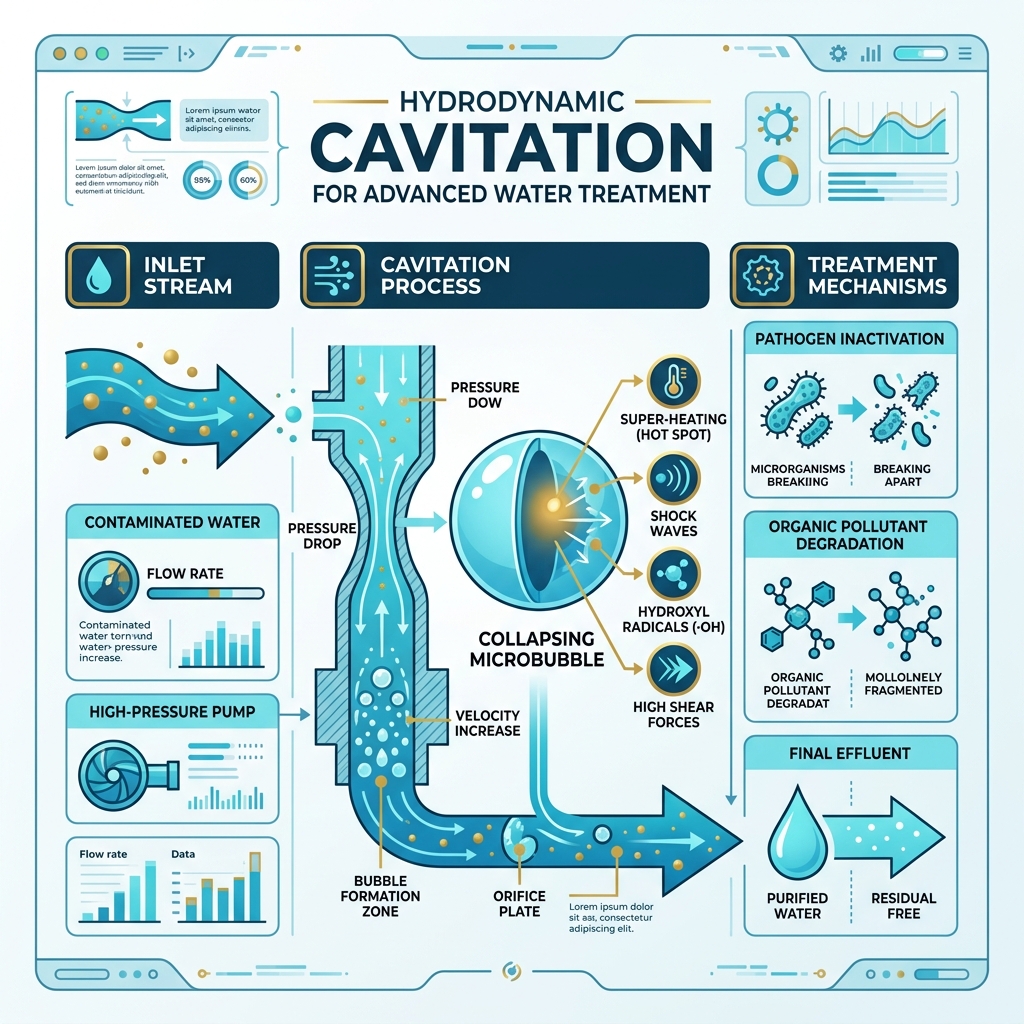
Biological treatment stages in municipal wastewater plants often fail to remove persistent pharmaceutical residues (such as carbamazepine, diclofenac, or metoprolol). Even standard downstream ozonation requires high ozone doses and extended contact times to degrade these stubborn compounds. The innovative HyKaPro process (Hydrodynamic Cavitation and Ozonation) addresses this limitation by using physical extremes to accelerate chemical degradation by orders of magnitude.
Research Focus
Combining hydrodynamic cavitation with ozone generates a highly potent Advanced Oxidation Process (AOP). Imploding microbubbles create extreme temperatures and shear forces, splitting water and ozone molecules into highly reactive hydroxyl radicals (⋅OH). The pilot study was published in 2025 with Dr. Markus Meier (Air Liquide) as co-author, in collaboration with IUTA, in the journal Separation and Purification Technology.
The Physical Principle of Hydrodynamic Cavitation
Cavitation refers to the formation and sudden collapse of vapor bubbles in a flowing liquid. In the HyKaPro reactor, wastewater is forced through a constriction (e.g. an orifice plate or Venturi nozzle). The flow velocity increases drastically, causing the static pressure to drop below the vapor pressure of water, which generates millions of microscopic steam bubbles (cavitation bubbles).
As the flow exits the nozzle and pressure recovers, these microbubbles collapse (implode) violently within fractions of a millisecond. This collapse occurs adiabatically and creates extreme physical conditions on the micrometer scale:
- Local Hotspots: Temperatures up to 5,000 Kelvin inside the bubble.
- Extreme Shockwaves: Local pressures up to 1,000 bar.
- High Shear Forces and Microjets: Liquid jets with velocities exceeding 100 m/s physically break down macro-pollutant molecules.
Synergy of Cavitation and Ozonation
When ozone (O3) gas is co-injected directly into the cavitation zone, it reacts under these extreme physical conditions. The heat of bubble collapse thermally cleaves ozone molecules into oxygen radicals, which instantly react with water to form hydroxyl radicals (⋅OH). These radicals are non-selective, extremely powerful oxidants with a much higher oxidation potential than molecular ozone.
Additionally, the violent shear forces of cavitation multiply the gas-liquid surface area by shearing ozone bubbles into tiny nanobubbles. This boosts the ozone solubility and the mass transfer coefficient (kL). Even highly persistent substances like Iopromide (contrast agent) are degraded and mineralized rapidly.
Economic and Operational Advantages
1. Reduced Ozone Demand
Due to the catalytic radical acceleration, the specific ozone demand for the same removal efficiency can be cut by 35% to 45%. This reduces generator wear and lowers plant power consumption significantly.
2. Elimination of Biologically Resistant Compounds
Molecules that are oxidized very slowly by molecular ozone (e.g., contrast agents) are successfully broken down by cavitation-induced hydroxyl radicals into biodegradable fragments.
3. Compact Footprint and Easy Integration
The cavitation reactor is compact and does not require large reaction tanks. The system is designed as an inline module that integrates directly into the secondary effluent channel, requiring minimal space.
Outlook
The HyKaPro process developed by Dr. Markus Meier demonstrates how merging fluid dynamics with chemical gas technology opens new pathways in environmental engineering. With tightening wastewater regulations, combining cavitation and ozonation will become a key technology for industrial and municipal water treatment.
Peer-reviewed publication:
A. Kumar, Y. Huaccallo-Aguilar, J. Schäfer, M. Meier, W. Ding, S. F. Reinecke, U. Hampel (Published: July 30, 2025).
Separation and Purification Technology, Vol. 378, 134558. ✓ Open Access
DOI: 10.1016/j.seppur.2025.134558
Co-authors (with ORCID):
Amit Kumar, Ysabel Huaccallo-Aguilar, Markus Meier, Wei Ding, Uwe Hampel, J. Schäfer, S. F. Reinecke
Funding & collaboration: Helmholtz Association HIL-A02; European Regional Development Fund (EFRE), AN 100689115; European Commission
Pilot plant at HZDR in collaboration with Air Liquide
Request an Engineering Audit or Feasibility Study
Are you evaluating quaternary treatment stages, looking to optimize oxygen gas dissolution efficiency, or dealing with PFAS remediation? Get in touch for an independent engineering review.
Schedule Engineering Review →