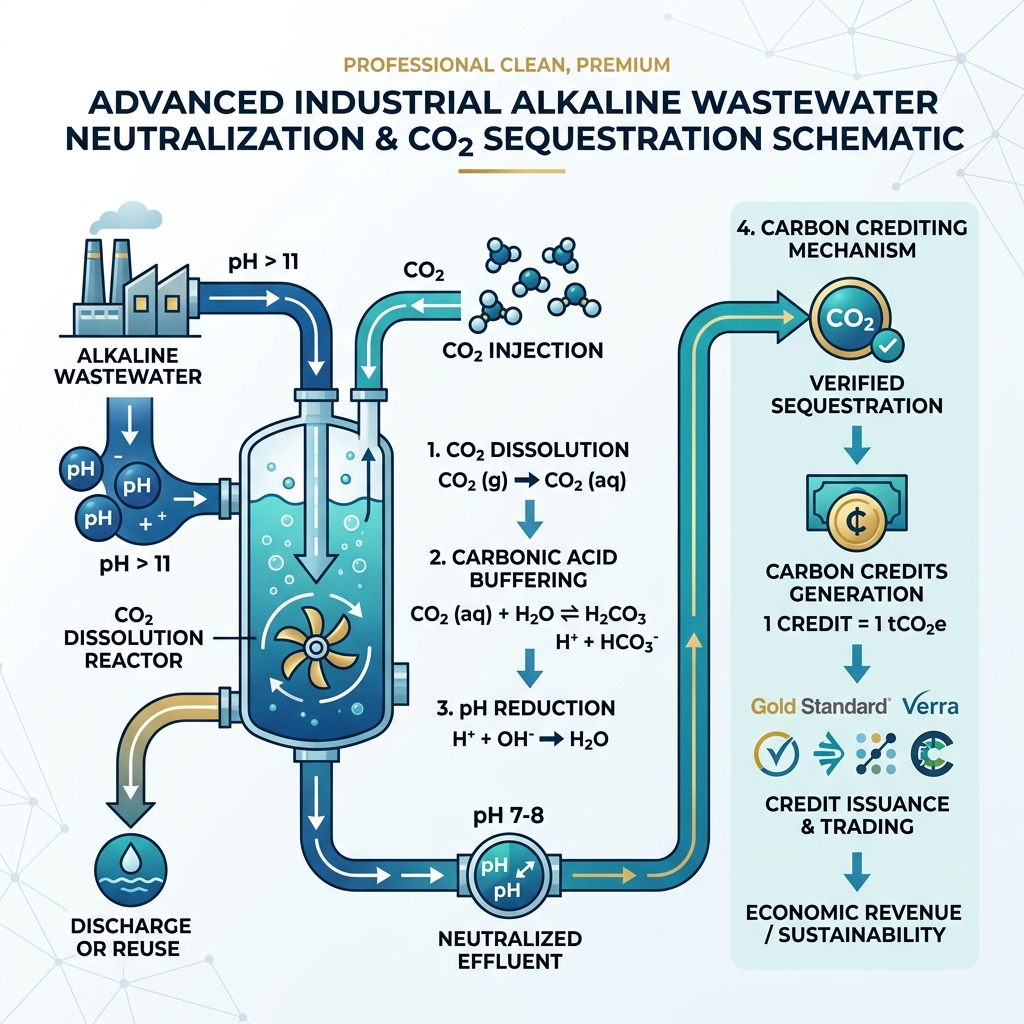
Alkaline wastewaters are generated in many key industries, including food and beverage processing, pulp and paper manufacturing, and chemical production. In order to comply with environmental discharge regulations, these highly basic streams (often pH 11–12) must be neutralized. The traditional method utilizes strong mineral acids (sulfuric or hydrochloric acid). A far more sustainable and economically attractive approach is the use of industrial carbon dioxide (CO₂). This process not only neutralizes the wastewater gently but also permanently sequesters the greenhouse gas and opens new avenues for carbon crediting.
Research Focus
By chemically binding carbon dioxide as dissolved carbonates and hydrogencarbonates, CO₂ is permanently locked within the water cycle (sequestration). This verified capture process can be certified as a carbon-offset method and marketed as carbon credits. The scientific paper was published in 2026 by Dr. Markus Meier in the renowned journal Environmental Science & Technology Letters.
The Chemistry of CO₂ Neutralization
When gaseous CO₂ is injected into alkaline wastewater, it dissolves physically and reacts with water to form carbonic acid (H2CO3):
CO₂ (g) ↔ CO₂ (aq)
CO₂ (aq) + H₂O ↔ H₂CO₃
The carbonic acid dissociates into hydrogen carbonate ($HCO_3^-$) and protons ($H^+$), which neutralize the hydroxide ions ($OH^-$) of the alkaline wastewater load:
H⁺ + OH⁻ → H₂O
In the typical discharge target pH range of 7 to 8, the carbon dioxide exists almost entirely as dissolved hydrogen carbonate ($HCO_3^-$). Since this ion is thermodynamically extremely stable, the CO₂ remains permanently bound in the water (increased carbonate alkalinity). Upon discharge into surface waters or the ocean, the carbon dioxide is sequestered over geological timescales.
Advantages Over Mineral Acids
1. Prevention of Over-Acidification (Self-Regulation)
Mineral acids such as sulfuric or hydrochloric acid have a steep titration curve. A tiny overdose can drop the pH of the wastewater instantly below 4, which destroys the biology of a treatment plant and causes severe pipe corrosion. Carbonic acid, being a weak acid, acts as a natural buffer, making over-acidification below pH 6.0 under atmospheric conditions virtually impossible.
2. Avoiding Salt Accumulation
Neutralization with sulfuric acid (H2SO4) increases sulfate concentration, while hydrochloric acid (HCl) raises chloride levels. Both ions lead to high salinization of receiving waters and accelerate sewer corrosion. CO₂ neutralization produces no additional corrosive mineral salts, merely increasing natural hydrogen carbonate alkalinity.
3. Verifiable Carbon Crediting
Since the CO₂ can be captured from industrial exhaust sources (such as biogas plants, combustion processes, or point-source capture), wastewater neutralization represents a practical form of CCUS (Carbon Capture, Utilization and Storage). Every ton of CO₂ bound in wastewater is permanently removed from the atmosphere. Using recognized verification standards (such as Verra or Gold Standard), operators can certify this sequestration to generate tradable carbon credits. This turns wastewater treatment from a pure cost factor into an additional revenue stream.
Conclusion
The publication by Dr. Markus Meier demonstrates how gas technology links wastewater engineering with global climate mitigation. CO₂ neutralization offers maximum process safety, avoids salinity, and creates new economic incentives via carbon crediting. In times of rising carbon taxes and strict environmental laws, it represents a prime example of circular chemistry.
Peer-reviewed publication:
H. Thomas, T. Hornig, A. Uguina, M. Meier (Published: April 14, 2026).
Environmental Science & Technology Letters, Vol. 13 (4), 487–492. ✓ Open Access
DOI: 10.1021/acs.estlett.6c00081
Co-authors (with ORCID):
Helmuth Thomas, Markus Meier, T. Hornig, A. Uguina
Funding & collaboration: Air Liquide Forschung & Entwicklung GmbH; Helmholtz-Zentrum Hereon; Carl von Ossietzky University of Oldenburg
Global potential: 11–32 Mt CO₂/yr, WAP process (Wastewater Alkalinity Preservation)
Request an Engineering Audit or Feasibility Study
Are you evaluating quaternary treatment stages, looking to optimize oxygen gas dissolution efficiency, or dealing with PFAS remediation? Get in touch for an independent engineering review.
Schedule Engineering Review →